

Why does Bali attract travellers, entrepreneurs, surfers, creatives, and wanderers from every corner of the world? An honest look at the island that people arrive at, leave, and somehow keep returning to.
Some are efficient. Some are soulless. Some feel like the start of a business trip you already regret.
And then there is Bali.
Ngurah Rai Airport is less like an arrival hall and more like a confession booth for modern life. People land here carrying invisible luggage: burnout, boredom, divorce papers, half written novels, half-baked start-ups, unresolved existential questions, and occasionally a surfboard. They arrive pale, overworked, slightly delusional, convinced that somewhere between the coconut trees and the WiFi password they might find the reset button.
And for reasons nobody fully understands, Bali keeps saying yes.
Why Do People from Around the World Keep Coming to Bali?
The Australian backpacker believes it belongs to him because he learned to surf here in 2008.
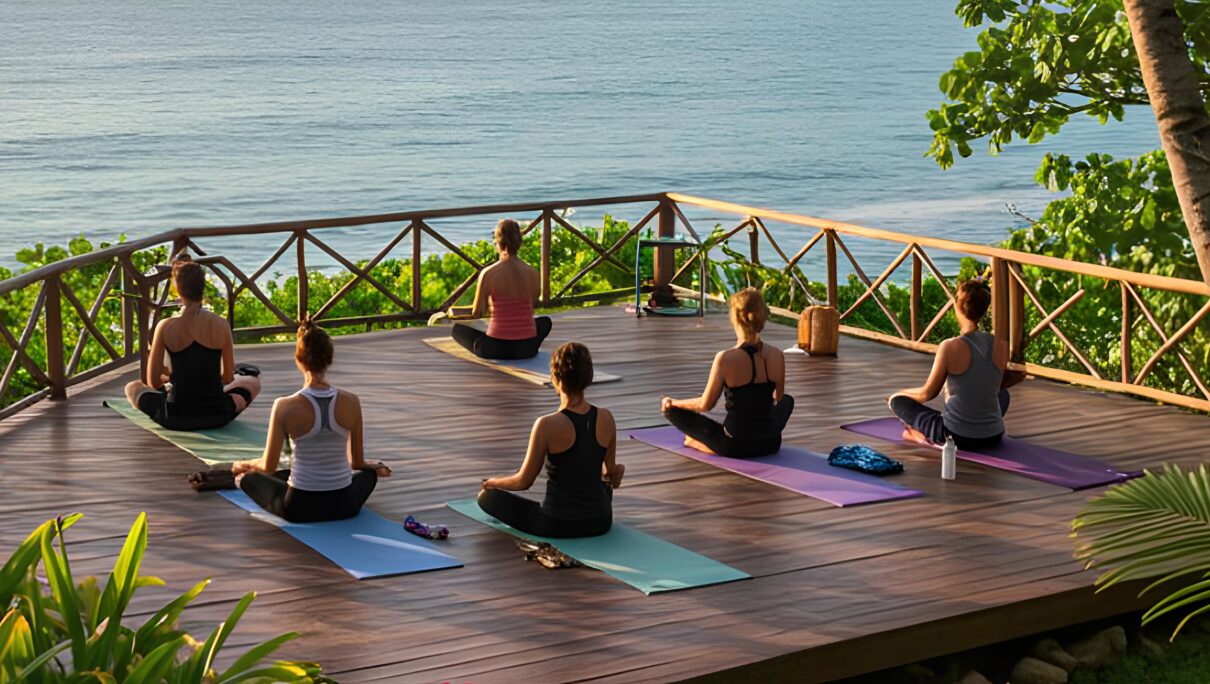
The yoga teacher from Berlin believes it belongs to her because she had a life altering smoothie bowl in Ubud.
The startup guy from San Francisco believes it belongs to him because he closed a funding round while sitting in a café with a view of rice fields.
They are all wrong. And somehow, they are all right.
Because Bali has quietly become a crossroads of the modern world.
But numbers alone do not explain the phenomenon.
The real explanation is stranger.
Bali is the only place where the global circus temporarily sets up camp.
Writers. DJs. Crypto optimists. Divorced architects. Burned out consultants. Twenty-two-year-old influencers who accidentally turned their abs into a business model. Fifty-year-old men who suddenly decide they are going to learn breathwork.
Everyone arrives with a plan.
Within two weeks, the plan dissolves.

(Source: Pinterest)
Morning is for pretending you are productive. The cafés are full of laptops and green juices and people speaking in mysterious professional dialects: scaling, funnels, content strategy. Entire businesses now run from beachside cafés with strong espresso and stronger WiFi.
By afternoon, productivity begins to melt.
Someone suggests a surf. Someone else suggests a massage. Suddenly everyone is at the beach pretending they always understood the importance of work life balance.
Bali has quietly perfected a very dangerous idea: that life should feel good most of the time.
The second strange thing about Bali is the price of luxury.
In most cities, beauty is expensive.
In Bali, beauty is suspiciously affordable.
A private villa with a pool costs less than a shoebox apartment in London. Lunch arrives in ceramic bowls that look like they belong in a design museum. A massage costs less than a cocktail in New York.
The math alone explains a lot.
A remote worker who feels ordinary in Paris suddenly lives like minor royalty here. The island quietly performs a psychological trick: it upgrades people’s lives without upgrading their income.
And people get addicted to that feeling very quickly.
But money isn’t the whole story.
If it were, Bali would feel like Dubai with palm trees.
Instead, it feels like something looser. Slightly chaotic. Occasionally ridiculous.
Traffic jams happen in rice fields. Chickens wander through yoga studios. A five-star restaurant might share a wall with a scooter repair shop. A high-end design café might be next door to a grandmother selling fried bananas.

(Source: Pinterest)
Bali is one of the few places left where the global and the local haven’t completely separated. They bump into each other daily, sometimes awkwardly, sometimes beautifully.
And from that friction, strange communities emerge.
Artists collaborating with software engineers. Surfers discussing philosophy with hedge fund refugees. Entire friendships formed over nothing more than a shared WiFi password and a mutual dislike of winter.
In other cities you need introductions.
In Bali you just sit at the next table.
Of course, not everything is romantic.
Bali can also feel like the backstage area of globalization.
Influencers filming identical videos of identical smoothie bowls. Entrepreneurs pitching identical ideas to identical investors. People reinventing themselves so frequently they forget their original job.
Sometimes the island feels less like a paradise and more like a very stylish waiting room for people who haven’t decided what to do with their lives. And yet that may be exactly the point.
Because Bali offers something that modern cities rarely allow anymore:
A pause.
Not a vacation pause. A deeper one.
The kind where people step out of their old life for a few months and try on a different version of themselves. Writer. Surfer. Founder. Yoga teacher. Human who sleeps eight hours.
Most of them eventually go home.
But they leave slightly altered.

(Source: Pinterest)
Which brings us to the final mystery.
Why Bali?
There are prettier beaches. There are cheaper countries. There are quieter islands.
And yet Bali continues to pull people from everywhere.
Maybe the secret is simple.
Bali doesn’t ask who you were before you arrived.
It doesn’t care if you were a lawyer in London, a DJ in Berlin, or a tired accountant from Melbourne who finally decided he hates spreadsheets.
Here you can start a company, write a book, learn to surf, drink too many coconuts, rethink your entire life, or do absolutely nothing for three weeks and call it healing.
Bali allows people to press pause on their biography.
And that, more than the beaches or the villas or the WiFi, might be the real reason everyone eventually passes through.
Because every once in a while, the world needs a place where people go not to arrive somewhere new, but to figure out who they are when nobody is watching.
Bali, it turns out, is very good at that.
Bali doesn’t chase people.
It simply waits.
And sooner or later, the world finds its way here,
and everyone passes through.
Imagery curated from Google, Pinterest, and our studio. If your work is here without a name, let us know and we’ll fix it.