How Indonesian hospitality kept something the modern service industry had to reinvent from scratch.
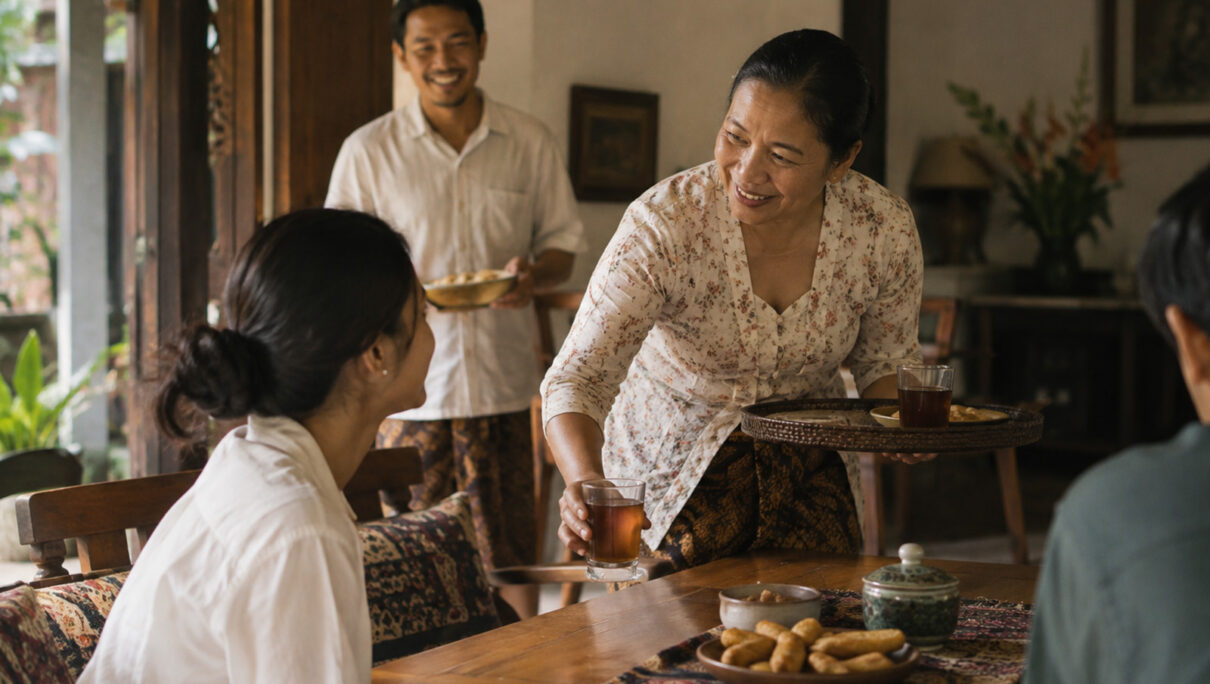
There is a particular moment that happens in almost every Indonesian home when a guest arrives. You have barely stepped through the door when somebody asks, “Mau minum apa?” Before you have answered, somebody else asks whether you have eaten. If you say yes, they may ask what you ate. If you say no, food appears. If you say you are not hungry, this is treated as a temporary condition that can probably be cured with fried bananas. Nobody waits for a request. You are a guest. That is apparently enough information for the entire household to go into operation.
This makes the modern obsession with “anticipatory hospitality” rather entertaining. The hospitality industry spent decades perfecting the transaction. You ask, they provide. You order, they deliver. You need something, you press a button. Very efficient. Very scalable. Very easy to put into a training manual. Then someone apparently realised that guests quite like it when you notice what they need before they have to ask. Suddenly there were guest profiles, personalised experiences, predictive service and software designed to remember that Mr. Smith prefers two pillows and no ice. Congratulations. We have arrived at Indonesian homes.
Your grandmother did not need a customer relationship management system to remember how someone took their tea. Your mother did not need an app notification to know that a guest who had been travelling all day probably needed food. Nobody needed a consultant to explain that a person sitting quietly in your house might appreciate a drink. There was no service blueprint, no guest journey and certainly no Canva presentation about “optimising human touchpoints.” You simply looked at the person and thought, “Maybe this human needs something.”
And this is where things get particularly funny. We have become very good at taking ordinary things that already exist, giving them impressive names and then selling them back to everyone as innovation. “Mau minum?” becomes anticipatory service. Remembering someone’s preferences becomes personalisation. Making sure someone has eaten becomes wellness hospitality. Somewhere, someone has probably spent three months developing a framework called The Future of Human-Centred Beverage Engagement. Meanwhile, an Indonesian auntie has already put tea on the table and is asking why you look so tired.
The hotel calls it personalised service. The algorithm calls it predictive intelligence. The consultant calls it anticipatory hospitality. Your friend’s grandmother calls it, “Kamu pasti lapar. Makan dulu.” Same instinct. Different invoice.

Perhaps that is why Indonesian hospitality can feel generous without necessarily being luxurious. It is not really about what is being offered. It is about noticing before someone has to ask. The glass of water arrives because someone noticed you were thirsty. The food appears because someone wondered whether you had eaten. The extra pillow arrives because someone noticed you looked uncomfortable. The care comes slightly before the request. That tiny gap is where hospitality lives.
And to be fair, Indonesia did not invent this. Cultures everywhere have their own traditions of hospitality and anticipation. What is particularly Indonesian is how deeply the habit is part of ordinary domestic life, especially through food. It is not a luxury feature. It is not a service standard. It is not something you have to train into people. It is simply part of what it means to have someone in your home and to treat them properly and even better, with compassion.
Which makes “Sudah makan?” a surprisingly sophisticated question. It does not really mean, “Have you consumed calories?” It means: I noticed you. You have been out all day. You must be tired. Come in. Sit down. Let me take care of you for a moment.
The commercial world has given this philosophy impressive names. Anticipatory service. Personalisation. Predictive hospitality. Customer experience. We just call it being a good host. Maybe that is the part we have underestimated about ourselves. We spent years assuming that modernity meant catching up with systems, technology and polish. Meanwhile, someone in an Indonesian household was already doing the thing. They just never thought to trademark it.
Imagery curated from Google, Pinterest, and our studio. If your work is here without a name, let us know and we’ll fix it.